What is a pollen filter?
The pollen filter, also known as a cabin filter, is usually located behind the glove box or at the bottom of the windshield.
These filters help keep the air inside the vehicle clean and free of allergens, dust and particulate pollutants, ensuring a healthier and more comfortable ride for all occupants.
Case study: Pollen filter support
In order for pollen filters to work optimally, they need suitable support to ensure their correct functioning.
This support is not only functional, but has also been developed with durability, resistance to adverse environmental conditions such as humidity and vibrations,... in mind. This support guarantees a constant performance throughout its useful life.
At OSFplastic, we have developed a solution for the manufacturing of the support, applying our experience in plastic injection and, specifically in this case, in bi-injection or bi-component technology.
With our “Contract manufacturing” service at OSFplastic we have provided a plastic injection molding solution for the manufacturing of the filter holder. From conceptual design to manufacturing and final packaging of the product:
- Collaborative design: Advice and collaboration in the design of the component, taking into account the functionality, resistance and aesthetic requirements requested by our customer.
- Material advice: With our experience and with the collaboration of our suppliers, we support the selection of the most suitable material for the component's needs.
- Serial mold manufacturing: Mold construction and manufacturing of first samples of the component for its validation.
- Serial production validation: Internal and customer approval of the serial production process and components.
- Component packaging: Selection of the most suitable packaging for the preservation of the component until delivery.
Bi-material injection molding technology in 2 steps
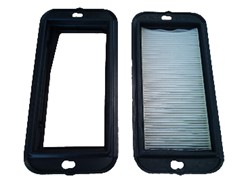
Bi-material or bi-component 2-step injection molding is employed using two different molds. It is a process in which a plastic part consisting of two different materials is manufactured by means of two separate molding operations.
To manufacture the support, in the first step, a material, in this case a rigid material (PP-Polypropylene) is injected into a mold to create a partially formed part.
Subsequently, this partial part is removed from the first mold and placed in a second mold.
In the second step, the second soft material (EPDM - thermoplastic elastomer) is injected around a part of the part to, in this case, perform the sealing function once assembled.
Advantages of 2-step bi-material injection molding
Bi-material injection molding has many advantages that make it a key technology for demanding projects:
- Multi-color designs: It is possible to manufacture parts with different colors in a single process.
- Combination of rigid and soft materials: Parts can be reinforced with a rigid interior to ensure consistency, while the soft exterior improves feel and functionality.
- Sealing: Ensures a perfect seal on rigid parts by combining materials with elastomers.
- Reduced investment in molds: By integrating several functions in a single part, the number of parts required is reduced, lowering the cost of molds.
- Functional optimization: The combination of materials makes it possible to meet the specific requirements of each component: rigidity in structure and flexibility in sealing.
- Production efficiency: The use of two molds ensures perfect integration between materials and a high quality end product.
- Customization: This process adapts to different designs and customer needs.
At OSF we study each customer's project to propose the materials and technology best suited to their needs.
For more information please contact us.